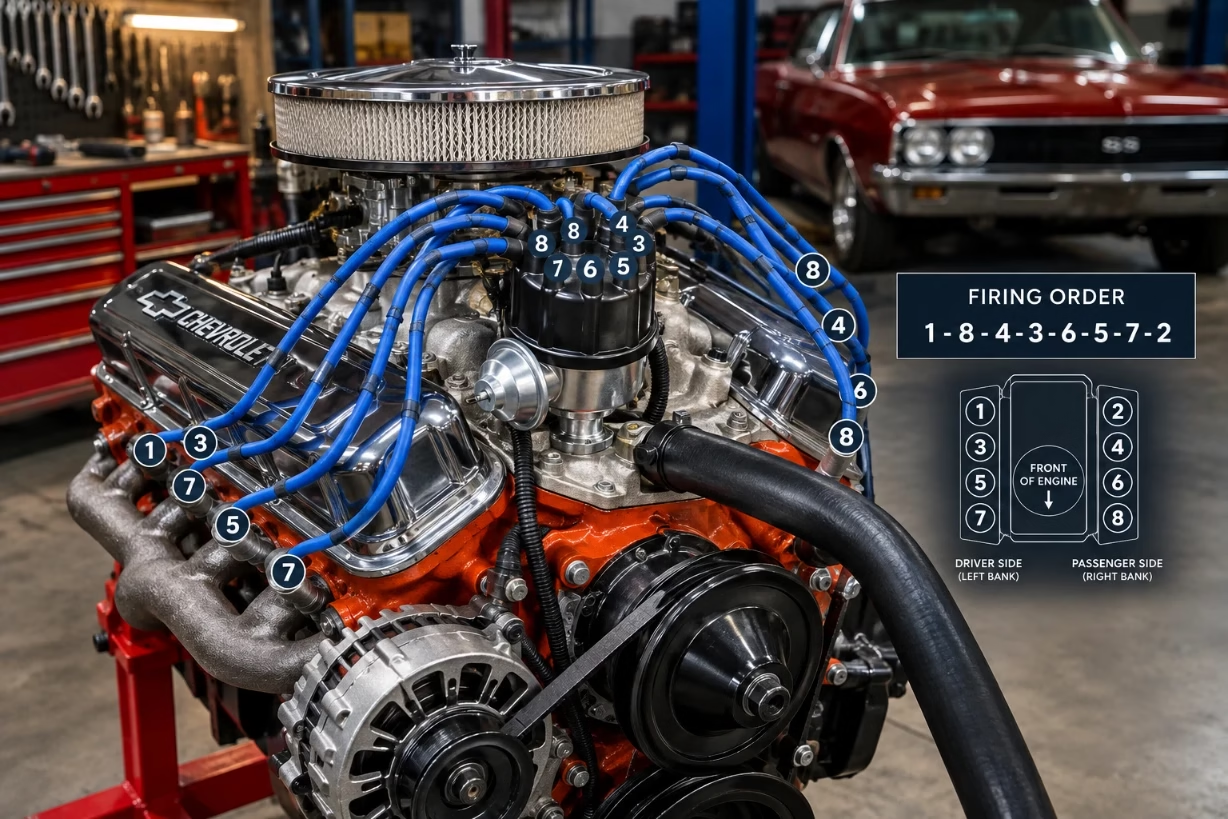
The correct small block Chevy firing order is 1-8-4-3-6-5-7-2, and on a standard clockwise-rotating distributor you follow that sequence clockwise around the cap, starting at cylinder 1.
What I Mean By “Small Block Chevy Firing Order”
When I talk about the small block Chevy firing order, I am talking about the exact sequence each cylinder gets spark as the engine turns. On a traditional small block Chevy V8, the firing order is always 1-8-4-3-6-5-7-2. That pattern decides how smooth the engine runs, how much power it makes, and whether it even starts at all.
If you have ever cranked an engine that just spat and coughed instead of firing up, there is a good chance the plug wires did not match the correct small block Chevy firing order. I have seen people chase bad carbs and bad coils for hours, and it turned out to be two wires swapped on the cap.
Small Block Chevy Basics You Need Before Talking Firing Order
Before I dive deeper into the small block Chevy firing order, I want to lay out a few basics. If you already know these, you can read quickly through, but they matter for getting the rest right.
The classic small block Chevy V8 has:
- Eight cylinders in a “V” layout
- One crankshaft shared by all pistons
- One camshaft that opens and closes all valves
- A distributor or coil setup that sends spark in a timed order
The firing order is the map for when each cylinder burns. Think of it like seat numbers at a ball game. Everyone has to sit in the right place or there is a mess. The small block Chevy firing order is the seating chart that keeps your engine from feeling like a stadium brawl.
Cylinder Numbering On A Small Block Chevy
Getting the small block Chevy firing order right starts with knowing how Chevy numbers the cylinders. This is where many people slip up, especially if they are used to Fords or other engines.
On a typical small block Chevy V8:
- Front of the engine is the side with the water pump and belts.
- Driver side bank is cylinders 1, 3, 5, 7 front to back.
- Passenger side bank is cylinders 2, 4, 6, 8 front to back.
Cylinder 1 is at the front on the driver side. When you read the small block Chevy firing order 1-8-4-3-6-5-7-2, you are jumping back and forth between those banks in a balanced pattern.
How The Distributor Works With The Firing Order
On older small block Chevys with a traditional distributor, that little round cap is where the small block Chevy firing order really comes to life. The distributor shaft spins in sync with the camshaft, and the rotor inside sends spark to one plug wire at a time.
Most common setups use a clockwise rotation on the distributor. That means if you look down at the cap from above, the rotor moves in a clockwise circle. Starting at whatever terminal is chosen as cylinder 1, you walk around the cap in a clockwise direction following the small block Chevy firing order sequence 1-8-4-3-6-5-7-2.
Step By Step: How To Wire A Small Block Chevy Firing Order
If you are standing over the engine with a box of plug wires wondering what to do, this is how I usually handle a small block Chevy firing order from scratch.
Step 1: Find Top Dead Center On Cylinder 1
First, pull the plug on cylinder 1. Put your finger over the spark plug hole and slowly turn the crank by hand using a ratchet on the crank bolt. When you feel air push out under your finger, that piston is coming up on the compression stroke. Keep turning until the timing mark on the balancer lines up with 0 on the timing tab. Now cylinder 1 is at top dead center on compression.
Step 2: Set The Distributor To Cylinder 1
With the cap off, look where the rotor is pointing. That point on the distributor body will be your number 1 plug wire position. Mark it with a pen or a small scratch if needed. Put the cap back on and note which terminal sits above that rotor position. That is your number 1 wire location for your small block Chevy firing order.
Step 3: Lay Out The Plug Wires In Order
Now route the wires according to the small block Chevy firing order 1-8-4-3-6-5-7-2, going clockwise around the cap. So the next terminal clockwise from 1 is 8, then 4, then 3, and so on until you go all the way around the circle.
Make sure each terminal on the distributor goes to the correct cylinder number on the engine block. Try to route the wires cleanly, not laying across hot exhaust or sharp edges. Some people like wire looms; some just zip tie in neat groups. The key is that the physical layout still follows the exact small block Chevy firing order, no exceptions.
Step 4: Double Check Everything Before You Crank
Once all eight wires are on, I always go back and trace each one out loud. I touch the cap at 1, say “one” and follow it to cylinder 1. Then I go to 8 on the cap, follow that to cylinder 8, then 4, 3, 6, 5, 7, 2. Catching a mistake now can save a lot of backfires and frustration later.
Why The Small Block Chevy Firing Order Is 1-8-4-3-6-5-7-2
People often ask why the small block Chevy firing order is not something simple like 1-2-3-4-5-6-7-8. The short answer is balance and smoothness. The long answer is about crankshaft design and how pistons move in the block.
The V8 crankshaft has offset throws that place pistons at different points in their stroke as it turns. Engineers picked the small block Chevy firing order 1-8-4-3-6-5-7-2 so power strokes are spread out evenly between both banks and across the rotation of the crank. That way the engine does not shake itself apart and runs with a smooth growl instead of a rough buzz.
Also, by using this firing order, they reduce stress on the crank and main bearings, since you do not get too many cylinders firing back to back on the same side. It is a balance between power, durability, and comfort. Over time, this small block Chevy firing order proved so solid that Chevy used it across many small block V8 engines for decades.
Engines That Use The Same Small Block Chevy Firing Order
The classic 1-8-4-3-6-5-7-2 firing order shows up on a lot of Chevy V8s. If you are dealing with a traditional small block Chevy, odds are good you are using this exact pattern.
Engines that commonly use the small block Chevy firing order include:
- 283 small block
- 302 small block (DZ and other variants)
- 305 small block
- 307 small block
- 327 small block
- 350 small block
- 400 small block (with minor internal differences but same firing order)
Many big block Chevy V8s also share the same basic 1-8-4-3-6-5-7-2 pattern, but you always want to confirm for your exact engine, because block design and balance factors can differ. For this article, I am focused on the small block Chevy firing order with the classic small block family in mind.
Common Mistakes With Small Block Chevy Firing Order
When someone calls me saying their engine will not start after a tune up, there are a few classic mistakes with small block Chevy firing order I look for right away.
Swapped Cylinder Wires
The most common error is simply two plug wires swapped. For example, someone might put the cylinder 5 wire where cylinder 7 should be. Since both are on the driver side rear, it is easy to mix them. With the small block Chevy firing order being so specific, even one swap throws off the whole timing of that bank.
Wrong Distributor Rotation Assumption
Another mistake is wiring the cap in the wrong direction. If a person is used to a different engine that turns the rotor counterclockwise, they might lay out the small block Chevy firing order counterclockwise. On a standard small block Chevy, the rotor turns clockwise, so the firing order must follow clockwise too.
Not At Compression TDC On Cylinder 1
If you set the distributor when cylinder 1 is at top dead center on the exhaust stroke instead of the compression stroke, the rotor will still point at a number 1 position, but you will actually be 180 degrees out. The engine might pop and spit, but it will not run right. So the small block Chevy firing order will look right on the cap, but the base reference is off.
How Firing Order Affects Engine Performance And Feel
The small block Chevy firing order does more than just let the engine run. It affects how rough or smooth the idle feels, how the exhaust note sounds, and even how the engine responds when you hit the gas.
A proper small block Chevy firing order keeps the power strokes spaced so the crankshaft spins with less twist and flex. The bearings live longer, and the block sees less stress. That is one reason small block Chevys got a reputation for taking abuse and still running. Chevy got the basics right, and the firing order is part of that foundation.
If wires are off or the firing order is mis-set in software on a modern engine control, you might notice:
- Rough or shaky idle
- Loss of power under load
- Backfiring through intake or exhaust
- Hard starting or no start at all
- Unusual popping or crackling sounds
All of those can point to problems with how the small block Chevy firing order is set up.
Electronic Ignition And Firing Order On Later Engines
Many later small block Chevy engines use HEI distributors or even coil-on-plug or coil-near-plug systems with engine control modules. You still have the same basic small block Chevy firing order, but the way it is handled changes.
On HEI systems with a large cap, you still route plug wires based on the same 1-8-4-3-6-5-7-2 pattern, and the rotor still turns clockwise. The coil is just built into the cap now. The small block Chevy firing order is baked into both the mechanical layout and the signals the module sends.
On engines controlled by a computer with separate coils, the engine control module or ECU fires each coil in the small block Chevy firing order sequence. The wiring harness and ECU programming are designed for that pattern. If you change cams or do performance work on these engines, you still respect that firing order unless you are doing serious custom engineering.
How Camshaft Design Ties Into Firing Order
The camshaft is like a mechanical brain that controls when each valve opens and closes. The small block Chevy firing order matches how the cam lobes are arranged along the shaft. When the cam turns, it calls each cylinder up in the right order for its intake, compression, power, and exhaust strokes.
If you install a performance camshaft in a small block Chevy, the cam is still ground to work with the stock small block Chevy firing order unless it is a very unusual custom design. So you do not change the firing order when you change the cam, you just change how long and how far the valves open, which affects power and torque.
Checking Firing Order Without A Full Rewire
Sometimes you do not need to strip everything down. Maybe you just feel something is a bit off with the way the engine runs. In that case, I like to do a quick visual and feel check on the small block Chevy firing order.
I start by finding the number 1 wire at the distributor, trace it to cylinder 1 on the block, then follow the cap around clockwise and check that each next terminal goes to the right cylinder number. If I find any wire that does not match the 1-8-4-3-6-5-7-2 pattern, I correct it and try again.
I also listen carefully when the engine idles. A proper small block Chevy firing order gives a steady rhythm, even if the cam is lumpy. An odd random miss or pop can hint at one cylinder not firing when it should, which could be wiring, spark issues, or compression problems.
How The Firing Order Shapes The Classic Chevy Sound
That deep, uneven but smooth rumble you hear from an old Chevy V8 is not an accident. The small block Chevy firing order 1-8-4-3-6-5-7-2, mixed with the V8 layout and exhaust system, creates that voice. Change the firing order, and the sound changes, even with the same displacement and exhaust.
When people say they can tell a Chevy, Ford, or Mopar by ear, part of what they are picking up is the different firing orders and how each one sends pulses through the headers and pipes. To me, a proper small block Chevy firing order is a kind of music you feel in your chest when you stand behind the car.
Quick Reference For Small Block Chevy Firing Order
To wrap all of this into a simple snapshot you can keep in your mind or notebook, here is the core information about small block Chevy firing order in one place.
- Firing order: 1-8-4-3-6-5-7-2
- Distributor rotation: Clockwise for standard small block
- Driver side cylinders: 1-3-5-7 front to back
- Passenger side cylinders: 2-4-6-8 front to back
- Number 1 cylinder: Front of driver side bank
If you remember those basics, you can walk up to almost any small block Chevy, wire it correctly, and have a strong chance it will fire and run the way it should.
Final Thoughts On Getting Firing Order Right
I have watched brand new builders and experienced mechanics both get tripped up by something as simple as the small block Chevy firing order. When you are leaning over that engine bay, it is easy to second-guess yourself. My advice is to slow down, say the order out loud as you go, and do one last full check before you hit the key.
Once the small block Chevy firing order is wired right and timing is set close, the engine usually tells you by how quickly it comes to life. That first crisp start, smooth idle, and solid throttle response are your reward for taking the time to respect how this classic V8 is supposed to fire.