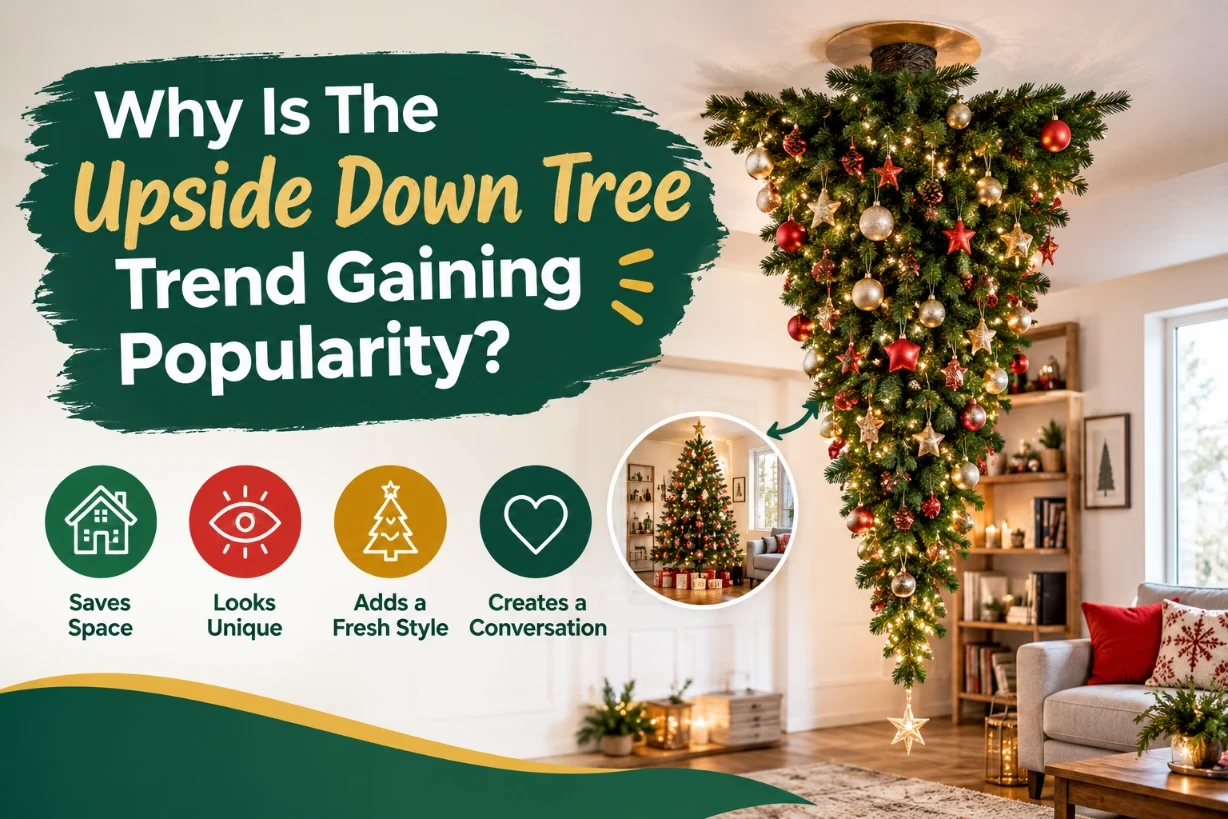
The upside down tree trend is gaining popularity because it feels bold, playful, and symbolic all at once. People love how an upside down tree saves floor space, photographs beautifully, sparks conversation, and flips holiday and design traditions in a way that still feels meaningful and cozy.
Why The Upside Down Tree Trend Suddenly Feels Everywhere
When I first saw an upside down tree hanging from a ceiling, I honestly thought it was a prank. Then I noticed something. Friends started sharing photos of their upside down tree on social media. Stores created entire displays around it. Designers began talking about it as a statement piece. At that point, it was clear this was more than a random idea. The upside down tree had turned into a real trend.
So why are so many people drawn to this strange, flipped version of a classic tree? A big part of the answer sits at the crossroads of emotion, design, culture, and social media. The upside down tree taps into nostalgia and rebellion at the same time. It keeps the warmth of tradition but puts it in a fresh, surprising shape.
In this article, I will walk you through the history behind the upside down tree, the reasons it is spreading so fast, and how people are using it in real homes, stores, and public spaces. My goal is to give you a full picture of why this trend works, not just a quick list of pros and cons.
Where Did The Upside Down Tree Idea Come From
The upside down tree might look like a pure social media invention, but the idea is older than it seems. In some parts of Europe, people used to hang trees from the ceiling as a religious symbol. The shape of an upside down tree could be seen as pointing toward heaven or as a symbol of the Trinity when arranged with three corners or points.
Over time, as modern Christmas traditions spread through Germany, Britain, and then America, the upright tree became the common version. The upside down tree faded into the background for a while. It survived in a few folk customs and rare artistic displays, then slowly started to return as a design statement. When big retail chains and hotels began hanging upside down tree installations in their lobbies, the look came back into public view in a big way.
So even though the upside down tree now feels new and edgy, it is actually rooted in older customs that mixed faith, art, and practicality. That blend is part of what makes this trend so interesting today.
The Emotional Appeal Of An Upside Down Tree
Trends that stick usually do more than just look cool. They make people feel something. The upside down tree taps into a very human mix of emotions. On one side, there is comfort. On the other side, there is a little shock.
When someone walks into a room and sees an upside down tree, their brain does a tiny double-take. The shape is familiar, the lights and ornaments are familiar, but the direction is all wrong. That small surprise creates a spark. It wakes people up, makes them laugh, or makes them curious. Those are strong emotional reactions, and they matter a lot in design.
At the same time, the upside down tree keeps all the cozy signals people love. You still get warm lights, shiny ornaments, family decorations, and that feeling of a special season or special space. So the upside down tree lets people keep their emotional traditions while also playing with them. That balance between comfort and disruption is a powerful reason this trend is spreading.
How Social Media Turned The Upside Down Tree Into A Trend
There is no way to talk about the upside down tree without talking about social platforms. The shape of an upside down tree is perfect for photos and short videos. It feels unexpected, and unexpected images tend to grab attention as someone scrolls past.
Influencers, content creators, and regular people all discovered something similar. Post a normal tree, get normal reactions. Post an upside down tree, and people comment, share, and ask questions. That engagement, repeated across thousands of accounts, pushes the upside down tree into more feeds and more minds.
Once home decor pages, lifestyle blogs, and design magazines feature the upside down tree, the trend shifts from “weird experiment” to “legit option.” People who might never have thought about hanging a tree start to picture how it might look in their own home or business. And because the upside down tree looks so dramatic, even a single shared post can make a strong impression.
Design Reasons The Upside Down Tree Works So Well
Beyond the emotional draw, there are very practical reasons designers and homeowners like an upside down tree. When I break it down, three main design benefits stand out.
1. Better Use Of Vertical Space
An upside down tree pulls the focus upward. Instead of a wide base that eats up floor space, the widest part of the tree floats near the ceiling while the narrow tip points down. This shape works especially well in small apartments, narrow living rooms, or busy shops where every inch of floor matters.
People living in city apartments with kids, pets, or lots of guests often mention that an upside down tree frees up space to walk around, sit, or play. You still get the drama of a large tree, but you do not lose half your floor to branches.
2. A Clear View Of Ornaments
On a normal upright tree, the heaviest, prettiest ornaments tend to sink toward the bottom branches. With an upside down tree, the widest layer of branches is now at eye level or higher. That means the most detailed ornaments can sit right where people can actually see them.
Shops and hotels use this to show off high-end ornaments or brand colors. At home, people use it to highlight family heirlooms or personalized pieces. The upside down tree almost acts like a hanging gallery, putting more of the decoration where the eye naturally lands.
3. Strong Visual Drama In Any Room
Even stripped of trend talk, there is no denying that an upside down tree is a bold visual anchor. It instantly becomes the main feature of a room. When the lights are on and the ornaments catch reflections, you get a floating, sparkling effect that feels magical.
Designers like this because it gives them a fast way to create a focal point. A single upside down tree can hold a large space together visually. It draws people toward it, which is perfect for entryways, hotel lobbies, conference stages, and store windows.
Cultural And Symbolic Meanings Behind The Upside Down Tree
People love symbols, whether they talk about them openly or not. The upside down tree speaks to a lot of quiet feelings and ideas that are common right now. When life feels unpredictable, many people are drawn to symbols of change, inversion, and new viewpoints. An upside down tree literally flips the normal order of things.
Some see the upside down tree as a sign of breaking from old patterns while still honoring the past. Others like the playful, almost rebellious spirit it sends. It can say “I respect tradition, but I am not afraid to twist it a bit.” For younger generations, this mix of respect and rule-breaking feels very natural.
There are also deeper personal meanings some people place into an upside down tree. For example, someone going through a big life shift may use an upside down tree as a symbol of turning their world around and still finding beauty in it. Even if that meaning is private, the object gives them a way to express that story in their space.
Practical Benefits Of Choosing An Upside Down Tree
Trends with staying power often offer clear, everyday benefits. The upside down tree is no different. Along with style and symbolism, it brings practical perks that make life a little easier.
Space Saving And Safer For Busy Homes
In homes with young kids or pets, a traditional tree can be a tipping risk. The base takes up space, and curious hands or paws sometimes pull on low branches. An upside down tree that is properly anchored to the ceiling or wall removes a lot of that risk. There is no base to trip over, and many of the ornaments sit higher out of reach.
For people in small homes, a hanging upside down tree can sit above a coffee table, dining table, or seating area without blocking use of that furniture. It turns dead air into a decorative zone.
Easier Cleaning And Maintenance
With a typical tree, dropped needles and broken ornament pieces gather under the lowest branches. Bending and crawling under the tree to vacuum can be annoying. When the widest part of the upside down tree is higher up, the floor under it is easier to reach. You can clean more quickly and see hazards sooner.
If you use an artificial upside down tree, storage can also be simpler. Many models break down into smaller sections that stack neatly. Because people often buy upside down tree options with lighter frames, they can be easier to lift and move than some heavy traditional trees.
Flexible Styling For Different Seasons
Even though most people connect the upside down tree with winter holidays, the shape can work all year. A neutral upside down tree with simple branches can be dressed for different seasons.
For example, you could use an upside down tree with soft green and white decor in spring, then swap in oranges and deep greens for fall. Some people like to turn their upside down tree into a hanging plant display by adding faux vines, dried flowers, or lightweight pots. This flexibility adds extra value, especially in small spaces where every item needs to earn its place.
How Businesses Use Upside Down Trees To Stand Out
Shops, restaurants, salons, and hotels have also helped push the upside down tree trend into the spotlight. When a business owner wants people to stop, look, and remember their space, an upside down tree does that job immediately.
Large stores will hang several upside down trees from high ceilings to create a tunnel of lights. Smaller boutiques might place one upside down tree in a front window, layered with products or colors that match the brand. Cafes add smaller upside down tree designs over communal tables to make the space feel more intimate and special.
Because customers often snap photos of anything unusual, the upside down tree can turn into free advertising. People share pictures of the tree, tag the location, and spread the image across social feeds. For a business, that mix of in-person impact and online reach makes the upside down tree a smart seasonal investment.
Common Myths And Concerns About The Upside Down Tree
Any trend that looks this different brings questions. I have seen a few myths pop up around the upside down tree, and it helps to clear them up.
“Upside Down Trees Are Always Less Stable”
Stability depends more on the mounting system than on the shape. A poorly installed traditional tree can fall just as easily as a badly installed upside down tree. When an upside down tree is secured to a stud, strong beam, or a heavy-duty stand designed for this purpose, it can actually be more stable than a floor-standing tree that children or pets can bump into.
“The Upside Down Tree Is Disrespectful To Tradition”
Some people feel uneasy about flipping a beloved symbol upside down. I understand that feeling, because traditions often connect to deep personal memories. At the same time, traditions grow by changing over time. The upside down tree does not erase the classic upright tree. It simply offers an alternate way to express similar feelings of warmth, celebration, and connection.
“You Cannot Decorate An Upside Down Tree Properly”
This concern usually fades once people see a well-decorated upside down tree in person. Ornaments still hang from branches, lights still wrap around the trunk, and a tree topper can sit at the point where the tree meets the ceiling or mounting bracket. The main difference is planning. Heavier ornaments should be placed on higher, stronger branches, and the color balance should be checked from multiple angles. Once you learn these basics, decorating becomes just as fun, if not more so.
Tips If You Want To Try The Upside Down Tree Trend
If you are curious about trying an upside down tree, it helps to start with a clear plan. The upside down tree is dramatic, but it does not have to be hard to live with. These steps can make your first try smoother.
Choose The Right Location
Look for a spot where the upside down tree will be seen from several angles without blocking movement. Near a window, over a coffee table, or in an entryway can all work well. Make sure you have a secure surface above or behind it for anchors or brackets.
Think Through Safety And Installation
If you live in a rental, you might not want to drill heavy holes into the ceiling. In that case, you can pick an upside down tree that mounts on a strong stand instead of hanging. If you do hang it, use proper hardware designed for weight-bearing, not light hooks. When in doubt, ask a handy friend or a professional for help.
Plan Your Decor Before You Start Hanging Ornaments
Because the upside down tree changes how weight is distributed, lay out your ornaments on a table first. Group them by size and weight. Place the lightest pieces near the lower, thinner branches and save the heavier ones for the upper, thicker branches. Step back often to see how the overall shape and color balance look from across the room.
Match The Upside Down Tree To Your Style
The upside down tree does not have to scream “novelty.” You can keep it simple and elegant. If you like minimal design, go for a slim upside down tree with white lights and a few metallic ornaments. If you love color and fun, choose bright garlands, bold ornaments, and playful shapes.
Your upside down tree can also tell a story. Maybe you use only handmade pieces from your family, or only items from your travels. When people ask about the upside down tree, you have both a surprising object and a personal story to share.
Will The Upside Down Tree Trend Last
Not every trend sticks around. Some flash, fade, and never return. I think the upside down tree has a better chance than most to stay part of the long-term design toolbox. There are a few reasons for this.
First, the upside down tree is based on a strong, clear visual idea. Trends grounded in a simple but striking shape tend to last longer than trends based only on a color or a slogan. Second, the upside down tree solves real problems around space, safety, and display in small homes and busy public areas. That practical value does not disappear when social media moves on.
Third, the upside down tree links to something deeper than novelty. It lets people play with tradition in a way that feels both respectful and bold. As long as people want to honor the past while still putting their own spin on it, the upside down tree will have a role to play.
Why The Upside Down Tree Trend Feels So Personal
When I talk to people who chose an upside down tree, I hear a mix of reasons. Some say they just loved the photos. Some say they needed the floor space. Others say they were going through a time of change and wanted their home to show that. All of these reasons are valid, and they show how flexible this trend is.
The upside down tree has moved from a strange visual gag to a real option people consider alongside classic choices. It can be serious, playful, spiritual, or purely decorative, depending on how you use it. That personal freedom is a big part of why the upside down tree trend keeps gaining popularity year after year.
In the end, the upside down tree is more than a flipped shape. It is a sign of how people today like to mix old and new, cozy and daring, familiar and surprising. If you feel drawn to it, you are not alone. The upside down tree may look unusual, but its rise in popularity makes perfect sense once you see everything it offers.