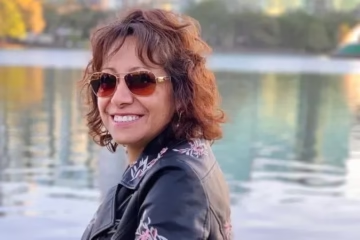
Searches for amanda nykyforuk georgia do not show a reliable, verified recent-news report identifying a Georgia resident by that exact name. Readers should treat unconfirmed posts, people-search pages, and copied claims carefully until a trusted news outlet or official public record confirms the person and event.
Who Is Amanda Nykyforuk Georgia Resident in Recent News?
The short answer is that there is not enough trustworthy public information to identify who “Amanda Nykyforuk Georgia” refers to in recent news. A name alone is not proof of identity, residence, employment, family connection, court involvement, or participation in a news event. That matters because online search results can mix together people with similar names, old records, unrelated profiles, scraped databases, and social media posts with little or no fact-checking.
For anyone searching amanda nykyforuk georgia, the most responsible conclusion is simple: no widely reported, clearly verified news story appears to establish that an Amanda Nykyforuk is a Georgia resident connected to a current public event. That does not prove that no person with that name lives in Georgia. It only means the claim has not been confirmed by reliable public reporting available through ordinary news searches.
That distinction may feel small, but it is a big deal in real life. A person can be pulled into online discussion because of a misspelled name, a shared last name, an inaccurate post, or a rumor that spreads faster than anyone checks it. Once a name appears in search results, readers may assume there is a serious story behind it. Sometimes there is. Sometimes there is not.
Why People Are Searching for Amanda Nykyforuk Georgia
People usually search a full name and a state for one of a few reasons. They may have seen the name in a Facebook post, a neighborhood group, a comment thread, a short video, a local rumor, or an article that did not provide much detail. They may also be trying to confirm whether a person mentioned in news coverage is the same person they know.
Search intent for amanda nykyforuk georgia may include questions such as:
- Is Amanda Nykyforuk a real person connected to Georgia?
- Was she named in a recent local news report?
- Is the spelling correct?
- Is a social media claim accurate?
- Are there official details about the reported situation?
Those are reasonable questions. The problem begins when searchers expect an answer before the facts are available. Search engines can show pages that repeat a phrase many times, but repetition is not evidence. A page may rank because it matches words someone typed, not because it has verified information about the person named.
What Can Be Confirmed About the Name
The surname Nykyforuk is uncommon, which can make it seem easy to connect every result bearing that name. In reality, uncommon names still belong to different families and individuals. Search results for the surname may lead to people outside Georgia, older records, professional listings, sports results, public documents, or unrelated social accounts. None of those results should be used to identify an individual without direct confirmation.
For the phrase amanda nykyforuk georgia, the available public search results do not establish a confirmed biography, verified Georgia address, workplace, age, family relationship, or reason for public attention. It would be irresponsible to fill those blanks with guesses. It would also be unfair to connect an ordinary person to an incident merely because a similar name appears elsewhere online.
A reliable article should separate facts from assumptions. In this case, the fact is limited: people are searching the phrase. The unproven part is the claim that there is a specific Georgia resident named Amanda Nykyforuk involved in recent news. Until that claim is backed by a credible source, it should remain unverified.
How to Check Whether a News Claim Is Real
If you came across a post about Amanda Nykyforuk in Georgia, pause before sharing it. Rumors often use urgent language. They may claim someone has been arrested, missing, injured, involved in an accident, named in a lawsuit, or connected to a public dispute. Those claims can cause real harm when they are wrong.
I recommend starting with the original source. Look for a recognized local newspaper, television station, public radio outlet, law enforcement agency, court record system, or government announcement. A real report should identify where the information came from, when the event occurred, and what facts are confirmed. It should not rely only on anonymous posts, screenshots without context, or a copied caption.
Check the Exact Spelling
Names are often misspelled online. One missing letter can send a search in the wrong direction. Before assuming a report concerns Amanda Nykyforuk, compare the spelling letter by letter. Also check whether a middle name, city, age range, photo, or direct quote is provided. These details can help separate one person from another.
A search for “Amanda Nykyforuk Georgia” may also be influenced by autocomplete suggestions. Autocomplete is based on search activity and patterns, not on a review of whether the claim is true. It should never be treated as proof that a person is newsworthy or tied to an incident.
Look for a Date and Location
A reliable report normally gives a specific date and a clear location. Vague wording such as “this week,” “near Atlanta,” or “a Georgia woman” is not enough to verify identity. If an article does not state the county, city, reporting date, agency involved, or source of the information, readers should be cautious.
Old stories are also regularly reposted as if they happened yesterday. A headline can feel fresh when it appears in a social feed, even if the original event happened years earlier. Checking the publishing date and the event date helps prevent accidental sharing of outdated or misleading content.
Use Official Sources With Care
Official records can be helpful, but they still need context. A court filing is not a conviction. An arrest record is not proof that someone committed a crime. A police statement may describe an early stage of an investigation, and details can change as more evidence is reviewed. Readers should avoid turning early reports into final judgments.
Likewise, public databases and people-finder sites are not strong identity sources. They can contain outdated addresses, incomplete names, incorrect relatives, duplicate profiles, and details collected from sources the public cannot easily verify. They should not be used to publish personal information about someone connected to an unconfirmed story.
Why Unverified Name Searches Can Cause Harm
It is easy to view a name search as harmless curiosity. But the person behind that name may be a private individual with a job, children, parents, neighbors, and friends. A false link between a person and a crime, accident, scandal, or emergency can lead to harassment, embarrassment, lost opportunities, and long-lasting stress.
Search engines do not always show the full context. A snippet may cut off key details. A repost may remove a correction. A viral clip may leave out the part where the speaker says they are unsure. The result is a messy trail where rumor can look more certain than it really is.
That is why the best answer to “Who is Amanda Nykyforuk Georgia resident in recent news?” is not a made-up profile or a list of possible personal details. The best answer is that identity and news involvement have not been publicly verified through dependable reporting. Responsible readers leave room for the facts to develop.
How Local News Reporting Usually Verifies Identity
Professional newsrooms generally do more than repeat a name from social media. Reporters may confirm spelling through authorities, speak with family members or attorneys, review public documents, request records, compare official statements, and give the named person a chance to respond when appropriate. Editors then review the story before publication.
Even strong reporting can be updated. Early reports may identify a person incorrectly, use an incomplete name, or lack details that become available later. Reputable outlets publish corrections when necessary. That willingness to correct the record is one sign that a source takes accuracy seriously.
By contrast, low-quality pages often publish thin content built around name searches. They may use broad terms such as “resident,” “breaking,” “exclusive,” or “latest update” without offering evidence. They can create the appearance of a story while providing no original reporting at all. When looking into amanda nykyforuk georgia, readers should avoid treating those pages as dependable sources.
What Not to Do When You See an Unconfirmed Post
If a post names Amanda Nykyforuk or any other private person, do not repost it just because it sounds believable. Do not share alleged home addresses, phone numbers, school names, workplaces, relatives, or private social media accounts. Do not message strangers demanding answers. These actions can turn uncertainty into harm very quickly.
It is also wise to avoid comments that state guesses as facts. Saying “that must be the same Amanda” or “I heard she lives in Georgia” may seem casual, but it can be copied and spread. Online rumors rarely stay in the small space where they began.
A better response is to ask for the original source, check the date, and wait for confirmed information. If the post involves a safety concern, missing person, emergency, or alleged crime, look for updates from the appropriate local agency or an established news organization. If none exists, do not assume the claim is true.
Search Results, Privacy, and the Right to Be Accurate
Searches for a full name can feel personal because they are personal. Behind every query is often someone trying to learn about a neighbor, a classmate, a coworker, or a person mentioned in a post. Curiosity is normal. Accuracy still comes first.
Privacy does not mean public events cannot be reported. It means private details should not be spread without a clear public-interest reason and reliable proof. When a person has not been confirmed as a public figure or a verified participant in a newsworthy event, there is little value in publishing a detailed profile based on uncertain information.
For that reason, this topic should be handled with restraint. The phrase amanda nykyforuk georgia may lead to additional verified reporting in the future, or it may simply reflect a misspelling, an unrelated name match, or an online rumor. Until credible reporting confirms the basic facts, readers should avoid conclusions.
Final Answer on Amanda Nykyforuk Georgia
There is currently no dependable public basis to describe Amanda Nykyforuk as a Georgia resident involved in recent news. Anyone searching amanda nykyforuk georgia should rely on established local reporting and official updates, verify names and dates, and avoid sharing personal claims that have not been proven. Being careful with someone’s name is not just good research. It is basic fairness.