
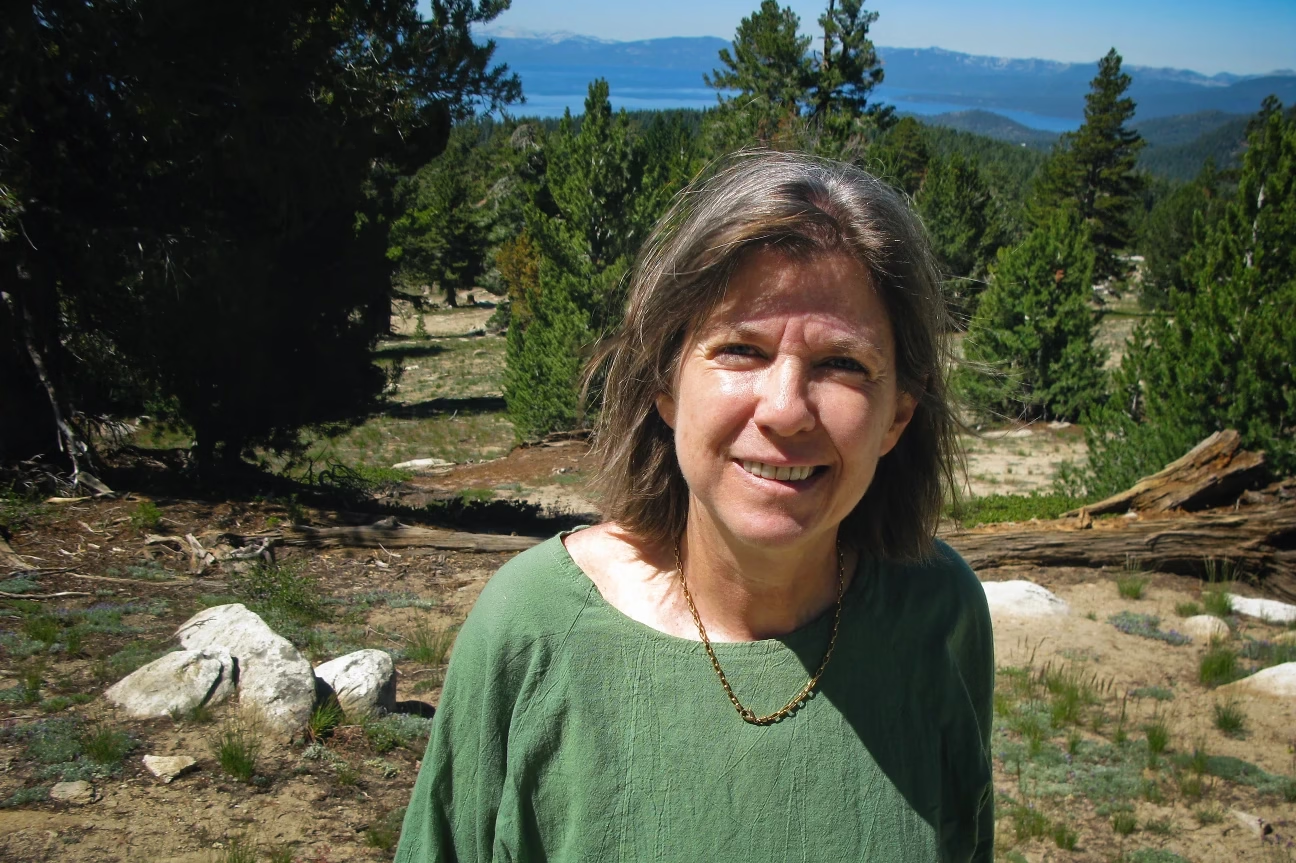
Judy Curry, better known as climate scientist Judith A. Curry, is an American climatologist whose research spans hurricanes, Arctic climate, clouds, and climate uncertainty. She is also widely discussed for her public critiques of mainstream climate change consensus and climate policy.
Who Is Judy Curry? A Clear Snapshot Of Her Career
When people ask who is judy curry, they are usually talking about Dr. Judith A. Curry, a PhD atmospheric scientist born in 1953 who built her career in climate and weather research. She served for many years as a professor and later chair of the School of Earth and Atmospheric Sciences at the Georgia Institute of Technology, one of the top engineering and science schools in the United States. During that academic career, she published more than a hundred peer reviewed papers on topics like hurricanes, clouds, sea ice, and climate feedbacks.
Over time, judy curry became known not only for technical climate work, but also for her role in science policy debates. She has testified several times before the United States Congress on climate science, uncertainty, and energy policy, and she is a fellow of major professional bodies such as the American Meteorological Society and the American Geophysical Union. She eventually left her tenured role and now leads a private company called Climate Forecast Applications Network (CFAN), which focuses on practical climate and weather risk forecasting for governments and businesses.
Why Judy Curry Matters In Climate Science
From a search and user intent point of view, anyone typing judy curry into Google is usually trying to understand two things at once. First, they want to know her scientific credentials and what she actually studied. Second, they want to know why her name often appears in arguments about climate change, climate models, and climate emergency language.
I will walk through both sides. On the science side, judy curry worked on very specific, technical problems: how hurricanes behave in a warming world, how Arctic clouds and sea ice interact, how to use satellite data to study the climate system, and how uncertainty in models affects long term projections. On the public debate side, she has argued that climate science has more uncertainty and more open questions than many media narratives admit, and she often pushes back on what she sees as “manufactured consensus” and oversimplified messages.
Academic Background And Career Path Of Judith Curry
Judith Curry earned her PhD in atmospheric science at the University of Chicago, a program well known for strong work in geophysics and climate. After that, she held research and teaching posts at several universities before joining Georgia Tech. Over the years she moved from assistant professor to full professor and then to department chair. In those roles, she supervised graduate students, ran research projects funded by agencies like NASA and the National Science Foundation, and helped shape large collaborative climate programs.
At Georgia Tech, judy curry was involved with projects on Arctic climate, satellite remote sensing, and how clouds influence the planet’s energy balance. These are not side topics. They sit right at the heart of how climate change is measured and modeled. Her work helped refine how models handle cloud processes and sea ice, which are still some of the biggest sources of uncertainty in climate projections.
After decades in academia, she stepped down from her Georgia Tech position around 2017 and turned her focus to CFAN and to writing, speaking, and blogging. Her blog “Climate Etc.” became a gathering point for scientists, engineers, and interested laypeople who wanted to discuss climate questions, sometimes from angles that do not match the majority view in large assessment reports.
Key Research Topics That Define Judy Curry’s Work
When you look closely at the research record of judy curry, a few major themes show up over and over: tropical cyclones (hurricanes and typhoons), Arctic climate and sea ice, cloud microphysics and thermodynamics, climate feedbacks and sensitivity, decadal variability in the climate system, and the philosophy and practice of climate modeling and uncertainty. I will dig into each of these so you can see what she actually did and why those topics matter.
1. Tropical Cyclones, Hurricanes, And A Warming World
One of the most widely cited parts of judy curry research deals with tropical cyclones, which include hurricanes in the Atlantic and typhoons in the Pacific. She studied how storm intensity, frequency, and duration might shift as ocean temperatures rise. In the mid 2000s, she coauthored influential work suggesting that the strongest hurricanes seemed to be getting more intense in several ocean basins. That research was seized on by both media and advocates as evidence of clear climate impact on extreme storms.
Later, however, judy curry and others pointed out that long hurricane records are noisy and that the observational record has many gaps, especially before satellites. Some follow up work showed that the picture was more mixed: intensity trends might be real but are hard to separate from natural cycles and data issues. That change in view, and her willingness to highlight uncertainties in her own earlier work, became one reason some people now see her as a more cautious or skeptical voice about simple climate narratives around hurricanes.
In plain language, her work in this area keeps circling one stubborn question: how much of what we see in hurricane behavior is due to human driven warming, and how much is natural variation in the oceans and atmosphere. Even now, that question is still not fully closed in the scientific literature.
2. Arctic Climate, Sea Ice, And Clouds
Another core part of judy curry research focuses on the Arctic, which is warming faster than the global average. She worked on field programs and modeling studies that looked at sea ice cover, low level Arctic clouds, and how they interact with radiation from the sun and from the Earth’s surface. This is a complicated energy balance problem. Thin clouds can trap heat, thick clouds can reflect sunlight, and ice and open water reflect very different amounts of solar energy.
Judith Curry helped evaluate regional climate models that tried to simulate Arctic conditions over seasons and over full years. She compared model outputs to real world observations from research ships, buoys, and satellites. That kind of comparison is crucial, because if models cannot get present day Arctic conditions right, it becomes harder to trust their projections of future ice loss and polar amplification of warming.
The feedback loop here matters for everyone, not just people living near the pole. Less ice means darker ocean, darker ocean absorbs more heat, and that extra heat can shift jet streams and weather patterns far to the south. By exploring how sensitive the Arctic system is to clouds and sea ice, judy curry contributed to a better picture of why the poles are both a warning signal and a wildcard in climate risk.
3. Clouds, Thermodynamics, And Microphysics
Clouds are one of the toughest parts of any weather or climate model. They form and break up on scales that are smaller than the grid spacing of large models, and they involve complex microphysics of droplets, ice crystals, and aerosols. Judith Curry coauthored a major textbook on the thermodynamics, kinetics, and microphysics of clouds, which many graduate students and researchers still use today.
In research papers, judy curry worked on cloud parameterizations, a technical term for how small scale processes are summarized in large scale models. She studied how different assumptions about cloud formation or droplet behavior could change the amount of sunlight reflected back to space or the amount of heat trapped in the atmosphere. These details might sound narrow, but they feed directly into estimates of climate sensitivity, which is the long term temperature response to a given amount of greenhouse gas forcing.
This line of work is one reason she often points to cloud feedbacks when she talks about uncertainty in climate projections. If models handle clouds incorrectly, the range of possible futures widens. To put it simply: get the clouds wrong and you get the climate wrong.
4. Climate Feedbacks, Sensitivity, And Uncertainty
A big portion of judy curry publications examine feedbacks in the climate system. Feedbacks are loops where a change in one part of the system makes another change larger or smaller. For example, warming melts ice, less ice makes the surface darker, a darker surface absorbs more heat, and that extra heat causes more warming. That is a positive feedback. On the other hand, more low reflective clouds might cool the surface and act as a negative feedback.
Judith Curry has argued that feedbacks involving clouds, water vapor, and sea ice are still not known with the precision needed to narrow climate sensitivity to a tight range. She acknowledges that greenhouse gases warm the planet, but she stresses that the exact amount of warming, the timing, and the regional patterns are more uncertain than simple “one number” sensitivity estimates suggest.
She has written about different types of uncertainty: not just statistical spread around a known mean, but also deep uncertainty about underlying processes, and scenario uncertainty about future human behavior. In public talks and written reports, judy curry uses this framing to argue for risk management approaches that account for a wide range of outcomes instead of locking in on a single forecast curve.
5. Natural Climate Variability And Ocean Cycles
Beyond long term warming trends, judy curry has also explored natural decadal and multi decadal variability. This includes patterns like the Atlantic Multidecadal Oscillation (AMO) and the Pacific Decadal Oscillation (PDO), which can tilt the climate system toward warmer or cooler phases over 20 to 60 year periods. These cycles affect hurricane activity, drought and flood patterns, and even Arctic sea ice behavior.
In her view, many observed changes over the last century reflect an interplay between human driven forcing and these slower natural swings. That means attribution studies, which try to separate human signal from natural noise, are very sensitive to how these internal cycles are modeled. Judith Curry often points to the early 21st century period of slower surface warming as an example of why internal variability cannot be ignored.
For someone trying to understand judy curry in search results, this focus on natural variability explains why she sometimes sounds more cautious than scientists who mainly emphasize greenhouse gas trends. She is not alone on this point, but she is one of the more high profile voices spelling out how tricky it is to untangle all those overlapping signals.
6. Philosophy Of Science, Consensus, And Climate Policy
In the later phase of her career, judy curry started writing more about the culture of climate science itself. She discussed peer review, group think, funding incentives, and how political pressure can shape what questions are asked and which results are highlighted. Her phrase “manufactured consensus” is often quoted, sometimes with more heat than light.
To unpack that, her basic point is that scientific consensus can be healthy when it grows from many independent lines of evidence, but it can become brittle if professional risk, media framing, or activist pressure make open disagreement costly. In her view, the climate field has moved closer to that brittle zone. She worries that overconfident messaging reduces trust when predictions miss or when uncertainties are exposed.
In energy and climate policy debates, Judith Curry argues for what she calls pragmatic risk management. That means treating CO2 as a risk factor worth reducing over time, but also keeping strong attention on adaptation, robust infrastructure, and resilience to climate variability with or without strong warming. To many readers searching judy curry, this puts her in a gray area between mainstream climate scientists and outright climate change deniers. She accepts basic greenhouse physics but questions some of the strongest emergency framing and some aggressive mitigation timelines.
Judy Curry’s Role Outside Academia: CFAN And Climate Etc.
When judy curry left her university role, she did not leave climate work. Through Climate Forecast Applications Network, she develops seasonal to decadal forecasts for things like rainfall, hurricanes, and temperature patterns. These forecasts are used by sectors such as energy, insurance, agriculture, and government planning. The idea is to turn theoretical research into concrete tools for managing risk.
Her blog “Climate Etc.” has also played a big role in her public image. On that platform, she posts essays on climate science, data issues, model performance, and policy debates. Guest posts from other scientists and experts add more viewpoints. The comment sections can be rough, with sharp disagreement, but they also show how many technically trained people still feel that not all questions about climate change have straightforward answers.
If you are trying to map the full meaning of the name judy curry, you have to include this public facing work. Many journalists, podcasters, and YouTube channels invite her to speak about climate uncertainty, model limits, and the social side of science, sometimes far more than they dig into her older technical papers on cloud microphysics.
Why So Much Debate Around Judy Curry?
Typing judy curry into a search bar does not just bring up neutral CV style pages. You will also see critics and supporters arguing about her credibility. Critics say that she overstates uncertainty, associates with climate skeptic groups, and gives quotes to media outlets that downplay climate risk. Supporters say she is one of the few established climate scientists speaking frankly about open questions and about the gap between technical papers and simplified talking points.
To make sense of this, it helps to separate three layers. First is her core scientific record, which is mainstream: peer reviewed work on hurricanes, Arctic climate, clouds, and feedbacks. Second is her interpretation of how much confidence we should have in model based projections and in single number sensitivity estimates. That interpretation is more cautious than what you see in many policy summaries. Third is her public communication, where short quotes and strong phrases can take on lives of their own in media and political contexts.
If you want a balanced view of judy curry, it is worth reading both her technical articles and her later essays, and also comparing them with the broader literature. Whether you agree with all of her positions or not, her career offers a case study in how complex, uncertain science interacts with politics, media, and public trust.
What Students And Curious Readers Can Learn From Judy Curry’s Work
Even if you do not plan to become a climatologist, there are a few practical lessons you can take away from studying the work and public life of judy curry.
First, climate science is not just one number or one graph. It is a network of fields: atmospheric physics, oceanography, glaciology, statistics, risk analysis, and more. Judith Curry moved across several of these, from detailed cloud physics to large scale feedbacks, and that range is part of why she has strong views on uncertainty.
Second, uncertainty does not mean ignorance. In her writing, judy curry often stresses that uncertainty is information. Knowing where you are unsure helps you design better studies, better models, and better risk strategies. For example, if hurricane projections have wide ranges, that might push you to invest in stronger building codes and flexible insurance systems rather than betting on one exact forecast.
Third, science is a human process. Labs, funding, peer pressure, and public expectations all shape what happens. Judith Curry’s break with parts of the climate science community, and her move into a more independent role, shows both the cost and the freedom that can come with stepping outside a strong consensus culture.
Summary: Who Is Judy Curry And What Has She Studied?
So when someone searches for judy curry, they are really asking about two overlapping stories. One is the story of a highly trained American climatologist who studied hurricanes, Arctic climate, clouds, sea ice, and feedbacks, and who helped improve our tools for forecasting and understanding weather and climate risk. The other is the story of a scientist who became a visible voice on climate uncertainty and on the social and political pressures inside climate research.
Across both stories, the central threads are careful attention to data, focus on physical processes like cloud microphysics and ocean cycles, and a strong interest in how confident we can truly be about the future. Whether you see Judith Curry as a cautious realist, a needed critic, or a controversial figure, her work on key research topics continues to shape how people talk about climate models, climate risk, and the space between science and policy.